
How Mississippi Warrants Are Tracked
A Mississippi warrant is never one record. It is several. A judge or judicial officer issues the order under that court's rules. The clerk logs it on the case docket. Then a sheriff, constable, municipal officer, or other authorized officer handles service. Each piece lives with a different office. No single public file ties them together. The DPS Criminal Information Center (CIC) acts as Mississippi's information-exchange node, and its Mississippi Justice Information Center (MJIC) unit runs authorized checks through NCIC/NLETS for officers and dispatchers. A positive return still has to be verified with the entering agency. The public cannot query CIC or MJIC, and Mississippi publishes no system that merges court dockets with local service records. So a personal warrant check goes back to the county or city court that issued the order. Pick the place tied to the citation or case in the Mississippi county directory. A city citation may belong to the Municipal Court clerk, even though that city sits inside a county.
Mississippi Warrant Queries Stay Agency-Only at CIC
The Mississippi Department of Public Safety houses CIC. The center stores and exchanges criminal information. Its MJIC unit serves authorized officers and dispatchers making wants-and-warrants checks. That describes an agency network, not a public name-search service. DPS also says a positive response should be confirmed with the agency that entered the record, since a state-level hit is not the final case disposition. The legislature created CIC in March 1998 under Miss. Code §45-27-5; §45-27-7 covers the state criminal-record repository. Neither provision turns an officer-only network into a public warrant index. DPS publishes no county participation list, no coverage table by warrant type, no historic date range, and no count of current warrants. The mission statement alone cannot tell you which local records are present in the system.
Mississippi DPS Criminal Information Center
State information exchange for authorized agencies; it is not a personal warrant-status line.
The separate Mississippi Bureau of Investigation handles investigative and fugitive work. Neither agency replaces the issuing court's docket or the local office responsible for service.
The Mississippi Warrant Database
Mississippi has several information layers. It has no single public database searching every active state and local warrant. Each record differs in purpose, operator, and access. A court docket documents case events. Local agencies track assigned service. CIC/MJIC and NCIC/NLETS support authorized criminal-justice checks. PAMEC gives registered public access to some court filings, and DPS Most Wanted publishes a selected fugitive program. The word "statewide" can describe a law-enforcement network's reach without promising that every local warrant is included. There is no uniform submission rule, no published back-date coverage, and no all-county feed. Ask the court or agency which record it holds and whether the particular order is still active.
| System or record | What it holds | Access and operator |
|---|---|---|
| Court docket | Filings, orders, and dated case events | Issuing court and clerk; public access depends on local rules and restrictions |
| Sheriff, city, or constable service record | Process assigned for service and return information | Relevant local law-enforcement agency |
| DPS CIC/MJIC and NCIC/NLETS | Authorized criminal-information and wants/warrants checks | Criminal-justice agencies, not the public |
| MEC/PAMEC | Nonrestricted filings and docket entries in adopting courts | Mississippi Judiciary system; registration and fees apply |
| DPS/MBI Most Wanted | Selected fugitive notices and tip instructions | Public program, not a complete warrant search |
Mississippi Court Dockets Do Not Equal a Warrant Index
Mississippi Electronic Courts (MEC) supports electronic filing and case records. Public Access to MEC (PAMEC) lets registered users view nonrestricted records in courts that adopted the system by local rule. The rollout covered Circuit, Chancery, and County Courts; Justice and Municipal Courts are not all on it. For a lower court, contact the clerk directly. Current non-attorney terms list a $10 annual account fee and $0.20 per search-result page. A no-match search may still count as a page. Fees and access depend on the live terms and the court's adoption. Even a docket line reading "Bench Warrant Issued" or "Capias Pending" does not prove the order is still active today. Ask the issuing clerk to explain the current docket and process. Mississippi docket access and CIC are separate things: one is a public court-record route for some cases, the other an officer-only criminal-information exchange. Neither is a complete public index. Sealed and restricted records stay out of public view even after registration.
From County Warrant to Statewide Index
Everything starts in a court with jurisdiction. A Circuit Court generally handles felony criminal dockets. A Justice Court covers many county traffic and misdemeanor matters, initial appearances, and preliminary felony steps. Municipal Courts take city ordinance, misdemeanor, and traffic cases. A County Court exists only in some counties. The right clerk depends on the court, not just the county name.
Mississippi record flow: Issuing court → local clerk docket → sheriff, city police, constable, or other service agency → authorized DPS CIC/MJIC query → NCIC/NLETS when an agency enters information.
The final steps are not an automatic feed. Mississippi publishes no complete technical path from every court docket into CIC or NCIC, and no rule requiring every active bench, traffic, municipal, civil, or local warrant to be entered. An order can remain valid even when no public site displays it. A local docket can also stay visible after service or recall until the record is updated.
Mississippi Has No Public County Feed Map
DPS publishes no county-by-county participation detail. It does not say which agencies enter which warrant types, or how often each record moves. No public date range, county dropdown, or active-warrant count exists either. So CIC/MJIC is not a real-time, complete Mississippi warrant list for the public. An officer can query an available record quickly. But nothing guarantees every local order enters the network instantly, or at all. That gap shapes what a blank result means. A missing docket event, no Most Wanted profile, or no county website hit does not prove a warrant is absent. Use the citation, notice, or known case to identify the court. Ask the clerk whether process remains active. Then contact the agency assigned to serve it. A statewide Mississippi database cannot replace this local confirmation. Note: Mississippi publishes court and judicial-district counts, but no authoritative total for outstanding or active warrants.
Federal Fugitive Warrants in Mississippi
Federal warrants run on a separate track. Mississippi is split between the Northern and Southern Districts of the U.S. District Court. A federal case does not become a county warrant just because an arrest happens locally. A federal docket may be public through PACER. Sealed or unserved process may not appear in a public case search. The U.S. Marshals Service works with state and local partners on fugitive task-force operations. The Gulf Coast Regional Fugitive Task Force is one. A task force executes or investigates fugitive process. It runs no public query for Mississippi county warrants. For a federal case, use the proper district and federal counsel route; for a separate Mississippi matter, contact the court that issued the state or local process.
Gulf Coast Regional Fugitive Task Force
Federal and local fugitive coordination; not a public warrant database.
For federal jurisdiction in Mississippi, use the Northern District Court or the Southern District Court. PACER handles eligible public docket searches.
Mississippi Federal Warrant Checks Need a District
A paper that cites a federal warrant or U.S. Marshals matter needs a district, court, and case number. Get those first. PACER searches by court or nationwide index. It is not a warrant-only search. Sealed process may not show. Marshals public district contacts handle federal work, not a self-service status check for a Mississippi county court warrant. A Mississippi state or city citation belongs in its Circuit, Justice, County, or Municipal Court. Jurisdiction follows the case, not your address. A county jail roster or an internet result settles neither federal nor local status.
Statewide Index vs Mississippi County Warrants
A Mississippi law-enforcement query lets officers trade information across jurisdictions. The warrant order itself still comes from a court and is served by a local agency. A county warrant list, when published, reflects only the scope its keeper describes. Neither view can stand in for the other. The county or city clerk keeps the court docket. The sheriff, police department, or constable may hold separate execution information on a Mississippi warrant.
| Question | State or national system | County or city record |
|---|---|---|
| Who can query? | Authorized criminal-justice users | Public access depends on the office and record type |
| What does it show? | Entered law-enforcement information | Court orders, docket events, or local service data |
| Is coverage complete? | No public completeness list was found | Local scope differs by court and agency |
| How to confirm a case? | Entering agency verifies an authorized positive hit | Ask the issuing clerk and service agency |
For the local record, open the county directory and follow the case to its issuing court. Use a Municipal Court if the citation names one.
SB 2333 Did Not Create a Mississippi Warrant Portal
Senate Bill 2333 proposed a misdemeanor-warrant system inside MJIC. It was aimed at criminal-justice agencies, not the public. Its intended Mississippi launch date was January 1, 2028. Electronic tracking would follow misdemeanor warrants across jurisdictions as they are issued, served, and recalled. The bill history tells the rest. It died in committee during the 2026 session. So no operational system or consumer search portal for Mississippi warrants came of it. The introduced text is bill language, not a case record. It is useful context for the system's limits. Read the introduced SB 2333 text and its official history for the Mississippi proposal and session status.
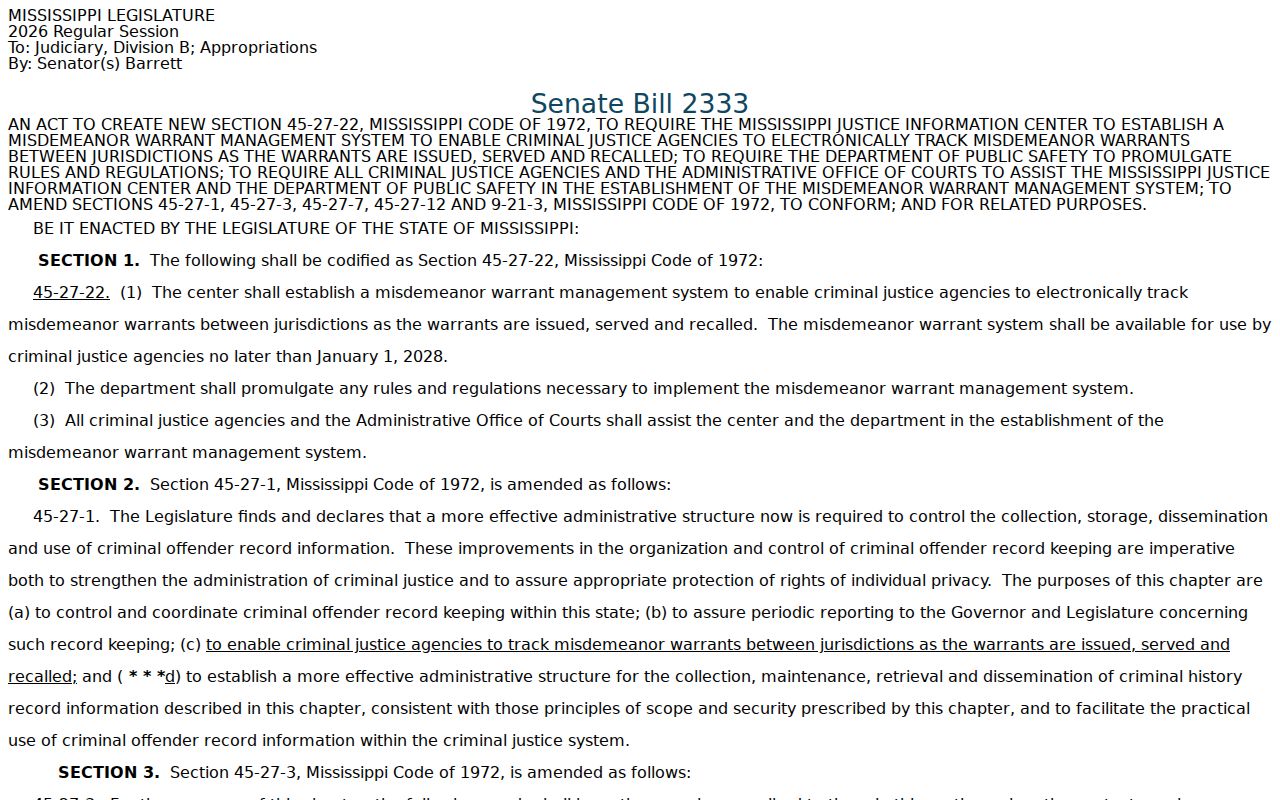
The proposal describes a possible agency tool. It offers no current way for a Mississippi resident to search personal warrant records.
How Mississippi Warrant Systems Went Digital
CIC's establishment in March 1998 is one documented milestone. DPS describes the center's ongoing role in criminal-information exchange. MJIC supports authorized wants-and-warrants checks through NCIC/NLETS. Mississippi courts also moved to electronic filing and dockets. PAMEC is available in courts that adopt MEC by local rule. That rollout does not guarantee every Justice or Municipal Court is covered. The state publishes no timeline for when each Mississippi county first computerized warrants. No date marks when every local agency joined NCIC. Full electronic entry across all Mississippi warrants cannot be assumed either. Access stays layered: court dockets, local execution records, restricted agency networks, and selected public notices each serve a different purpose.
SB 2230 Changes Warrant Issuance, Not Lookup
Mississippi lawmakers changed how warrants get issued in 2026, not how the public looks them up. SB 2230 broadened §99-3-47 so electronic applications and signatures now work for misdemeanor warrants as well as felony matters. The bill describes secure transmission, time and date logging, and live interaction with the judge, which may happen by video or teleconference. Electronic form alone does not authorize a no-knock warrant. Those rules govern how an application is presented and issued. What the law did not do is build a public warrant registry, a search-by-name interface, or a promise that every local order reaches CIC. The as-sent text and bill history document the change in full. Before quoting the code section, check how Mississippi has currently codified it.
Mississippi HB 1142 Studies Bench Warrant Service
House Bill 1142 takes a quieter path in Mississippi. Its final form creates a Mississippi Service of Bench Warrants Task Force to study issuance, service, notice, and possible electronic transmission through MEC, with a report due in 2026. It is a study and coordination measure. It is not a new public lookup system. The final bill text and conference report describe the scope. The task force's membership and meetings are not yet confirmed. Until they are, treat it as work in progress rather than an operating program. To confirm a particular bench warrant, a reader still needs the issuing clerk and the local agency that received the order.
After a Mississippi Warrant Order, Confirm Each Record
A recall or quash order changes the court record first. The local service agency and any law-enforcement system entry may update on separate tracks. DPS says an authorized positive return is verified with the agency that entered it, but public material does not state how long every local update takes. A docket entry alone cannot establish that each copy or operational record has changed. For a personal case, ask the issuing clerk for the written disposition and for the name of the agency that received process. If the court says an officer or sheriff keeps a separate record, contact that agency through its official local route. Uncertain results or arrest risk call for a licensed attorney. The county directory links to the proper local layer. A city matter may require its Municipal Court and police rather than the Mississippi county sheriff alone, so check both layers before assuming the record is closed. Note: Court, service, and law-enforcement records in Mississippi can update on different paths, so keep the court's written confirmation.