
How Mississippi Runs Its Most Wanted List
Mississippi's Most Wanted program is run by the Department of Public Safety (DPS) together with the Mississippi Bureau of Investigation (MBI), and partner agencies supply the cases. The public page posts notices and explains how to send a tip. What it does not offer is a search tool. There is no county selector, no case-number query, and no way to filter active from cleared. It is a notice channel, not a docket or a full warrant database, so most outstanding warrants never appear on it. When the program launched in 2021, it opened with ten selected cases. That figure is a launch fact only. It says nothing about how many notices are posted now or how many active warrants exist statewide. Agencies choose which cases go public, and Mississippi publishes no selection criteria, county participation map, or fixed update schedule for the program.
Mississippi DPS Most Wanted
Official selected fugitive notices and public tip instructions. It is not a statewide active-warrant search.
The official program page shows the heading and the tip route. Mississippi posts no fugitive cards or identifying details there. The DPS program launch notice covers the historic start and the partner model, and notices can change. Confirm any matter with the issuing court.
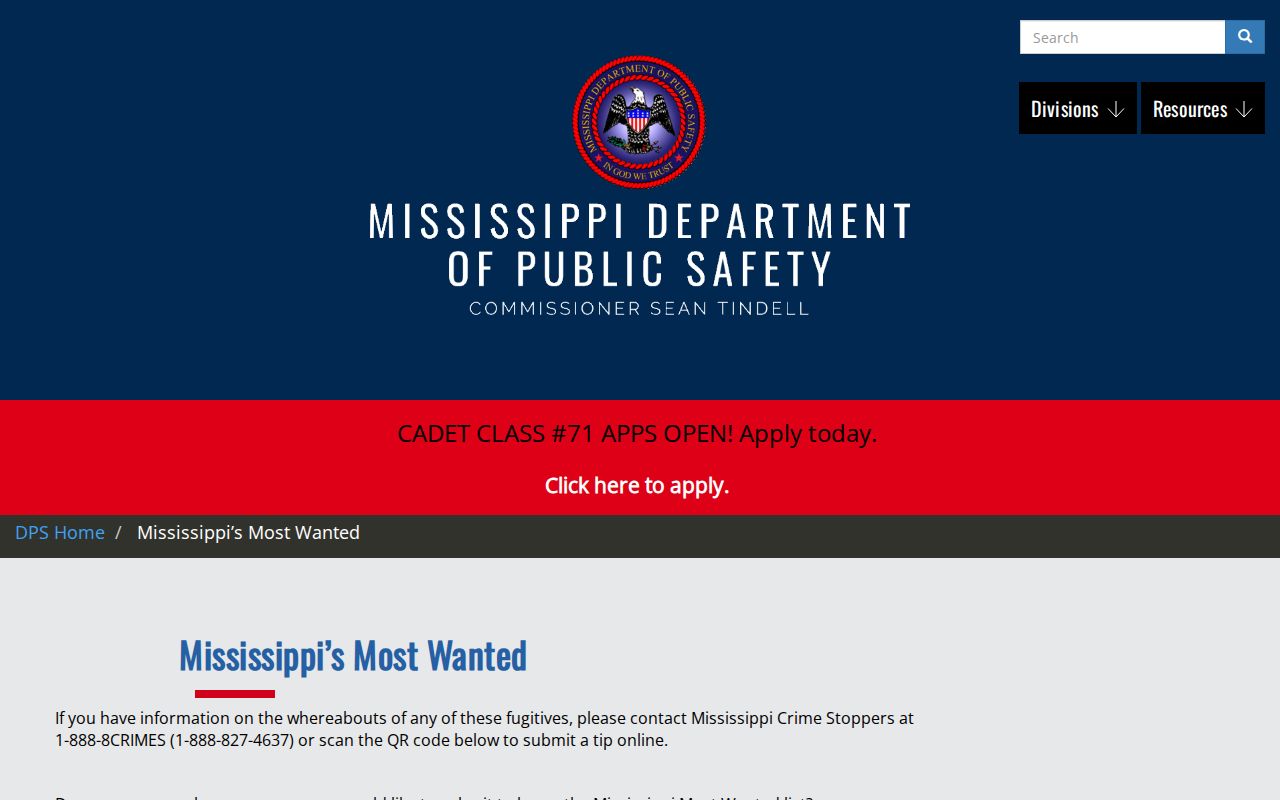
The image is a program-page overview, not a copy of a public wanted roster.
Mississippi DPS Submissions Are Agency-Only
DPS also links a submission form, and that form belongs to agencies alone. Mississippi built it for law enforcement, which must confirm a valid active warrant and verify that the warrant was entered into NCIC before sending agency contacts and supporting material. It is not a public search form. Nobody checking their own status should send personal information through it. The review step exists because the Most Wanted product is curated, and the public sees only what agencies choose to publish. The court order and the execution record stay with their own offices. So an ordinary reader cannot submit a name, and DPS will not certify a warrant for you. If you have a live case in Mississippi, call the issuing court and ask which sheriff, city police unit, or other agency received process.
MBI Special Operations
The state unit supports fugitive operations and coordinates the selected Most Wanted program with agencies.
Reporting a fugitive and checking your own case are different jobs. Mississippi's agency form feeds a program; a court clerk explains a docket.
Statewide or County Most Wanted in Mississippi
Mississippi's state program and county sheriff notices serve different purposes. The state feature may share fugitive alerts drawn from several jurisdictions at once. County agencies, meanwhile, might publish local notices, answer a phone inquiry, or offer no public list at all. There is no statewide roster showing which counties participate, so use the official local route for the county tied to the court case. And don't mistake a county jail roster for a wanted list. A custody search reports who is booked into a detention facility at a given moment. It says nothing about whether someone outside custody has an unserved warrant, and booking details may have nothing to do with warrant status.
| Public channel | What it may show | What it cannot confirm |
|---|---|---|
| DPS/MBI Most Wanted | A selected fugitive notice and tip instructions | Every Mississippi warrant, bond, or current court status |
| County sheriff notice or inquiry | Local information the agency chooses to publish or confirm | A statewide list or a separate city-court docket |
| Municipal or Justice Court | The docket and orders within that court’s jurisdiction | Records maintained by another court or service agency |
| Jail roster | Custody or booking information | All outstanding process or a court disposition |
Pick a county from the Mississippi county directory to reach its official local route. A city citation may instead belong to the Municipal Court named on the ticket.
Note: A page of selected names or current bookings is not a statewide warrant status service.
Mississippi Crime Stoppers Has No Single Reward Schedule
DPS counts 33 active local Crime Stoppers programs across Mississippi. These are nonprofits run by volunteer boards that raise their own funds and pay rewards for tips that help solve local cases. What the state does not publish is a shared reward schedule. No single amount, eligibility rule, payment condition, or response time applies to every program. So don't assume each Most Wanted notice carries a reward, or that any reward relates to a warrant-status question. The statewide tip number and the online P3Tips route exist for sending information about selected fugitive notices. Neither channel will verify your own court case. Someone checking personal status in Mississippi should contact the court, and a person helping a relative should use that route with consent.
Mississippi Crime Stoppers
DPS describes local programs and their public tip role. Reward rules depend on the local program.
Statewide Tip Route
DPS lists 1-888-8CRIMES (1-888-827-4637) and P3Tips for tips, not legal status checks.
Sending a Mississippi Tip Safely
A tip about a public fugitive notice belongs in an official channel. Mississippi's statewide Crime Stoppers page lists 1-888-8CRIMES and P3Tips, and a local Crime Stoppers organization may set its own terms. The state guarantees no common reward amount and no response timeline. Never approach or try to detain anyone because of a public notice.
- Open the official DPS or local Crime Stoppers instructions and choose the listed phone or online tip route.
- Share only information relevant to the notice and follow the service’s instructions for keeping a tip anonymous.
- Ask the local program whether it uses a reference number or has specific reward terms; do not assume the same rule applies statewide.
- If the question is whether your own case has a warrant, contact the issuing court or an attorney instead of using a tip line.
Tip safety: Use an official channel and keep distance; a Crime Stoppers number is for information, not a warrant-status check.
Tips are one-way leads to Mississippi agencies. They won't return written confirmation of a warrant's current status.
Gulf Coast Fugitive Work Is a Separate Mississippi Layer
The U.S. Marshals Service runs a Gulf Coast Regional Fugitive Task Force that pulls in federal and local partners. Its work supports fugitive investigations and the execution of process. It is not a public warrant index, and it offers no self-check phone line. Agencies may coordinate on one case, yet their records stay distinct. Federal arrest process, Mississippi state court warrants, and county sheriff service records never merge into one file. Mississippi also sits in two federal judicial districts, Northern and Southern. Federal case records belong to the right Northern District or Southern District U.S. District Court. Once you register, PACER opens public access to federal dockets. A docket search there is not a warrant-only query, and sealed or unserved process may not show up. For a federal concern, name the district and use the federal court or counsel route. For a separate local matter, return to the Mississippi court listed on the citation or notice.
Gulf Coast Regional Fugitive Task Force
Federal and local fugitive coordination, separate from a public state Most Wanted search.
Note: Task force involvement does not establish that a local Mississippi warrant was entered into every state or national system.
Mississippi Most Wanted or Active Warrant
A Most Wanted notice is a curated alert, not a case file. An active warrant is judicial process. It can exist whether or not a fugitive page features the person. Most people with an active warrant in Mississippi never appear on a state listing. The DPS page promises no completeness, and no public statewide warrant search exists to compare it against. So ask the court that issued the order whether the warrant is still active. Contact the agency handling execution only if needed. A PAMEC result may show a docket event in an adopting court, but a "Bench Warrant Issued" label does not settle current service status. A sheriff's notice has its own limits. It may cover only that agency's local cases.
| Record | Purpose | Confirmation route |
|---|---|---|
| Most Wanted notice | Selected public notice and tip request | DPS program page for notice; court for case status |
| Active court warrant | Judicial process tied to a case | Issuing court and assigned service agency |
| Law-enforcement entry | Authorized operational information exchange | Entering agency verifies a positive hit |
Mississippi Has No Statewide Warrant Amnesty
Mississippi has no current statewide warrant amnesty and no state-run warrant roundup. A city or county can offer local relief. That offer binds no other court. Biloxi's 2016 resolution notice is one dated example of a local effort to resolve certain outstanding cases. It was a one-time event. It does not show the same relief remains available today. Before relying on any announcement, check its date, the named court, the case types covered, and any required appearance. Read whether the notice says a judge will recall process or waive a fee. If nothing current applies, ask the issuing Mississippi court about its standard appearance, motion, payment, or bond steps. Do not assume a Most Wanted entry can be cleared by contacting a tip program. No single public portal lists every local warrant or relief offer in Mississippi. Note: The named court controls event dates and eligibility, not the statewide fugitive program.
Finding Your Own Name on a Mississippi List
Seeing your own name on a Most Wanted card is startling, but the card is not a complete case file. It may omit the docket, bond conditions, the service return, the current court date, or another agency's updated record. Contact a licensed attorney first. Then contact the issuing court. For a local sheriff or city court route, pick the right area in the county directory. If an attorney or clerk confirms the matter is a Mississippi state or local case, ask which court issued the order and which agency received it. If it is federal, use the appropriate district court and federal counsel. Skip the anonymous tip line for personal case advice. Removing a card proves nothing about the warrant either. Only the court can confirm a recall.
Important: If you believe a notice concerns you, speak with a licensed attorney and the issuing court before acting; only the court can confirm its current order.
Mississippi Most Wanted Labels Do Not Decide Court Status
A card marked captured or removed is a program update. It is not the final word from the court. The label alone cannot tell you whether the warrant was recalled, whether another case stays open, or what bond or hearing applies. DPS posts both active and captured cards, with no published refresh interval or history policy. A missing profile proves just as little. Absence is not proof that no warrant exists. DPS picks notices for a program, while local courts and agencies keep the case and service records. Use the citation or case number to reach the right Circuit Clerk, Justice Court Clerk, or Municipal Court Clerk in Mississippi and ask whether the order remains in effect. A docket event can help you locate the case. Current status must come from the court that holds the record. Note: Public fugitive notices, court dockets, sheriff records, and jail rosters each differ in scope and update practice.