
Mississippi Warrant Checks
A useful Mississippi warrant check starts with documents in hand: a citation, a court notice, a bond paper, or a case number. That paper tells you which court owns the case. It may be Circuit Court, Justice Court, a County Court where one exists, or a city Municipal Court. These levels are not interchangeable. The 2026 Mississippi Judiciary Directory maps court locations and jurisdictions, but the court named on the original record is still the better starting point. Mississippi has no public statewide active-warrant search. A docket search, a sheriff inquiry, and a law-enforcement wants-and-warrants check answer three different questions. Pick the route that matches the record. Ask the clerk which agency holds service information. If the case could mean immediate arrest, a felony, or bond forfeiture, call a licensed attorney before you travel anywhere.
- Read the citation or notice and identify the issuing court, city or county, and case number if shown.
- Ask the clerk whether the court participates in Mississippi Electronic Courts. Registered public access covers nonrestricted records in adopting courts, not every local court.
- Call the court clerk to confirm whether a docket event still reflects an active order and what action is required. A clerk can explain procedure, but not provide legal advice.
- Ask which sheriff, city police department, constable, or other agency received the process if service status matters. Local public search options vary.
- For a specific existing agency record, make a narrow request under the Mississippi Public Records Act. A request does not create a real-time law-enforcement query.
- For a city ticket, contact the Municipal Court named on it. For a county matter, select the county route below and confirm the proper lower court.
Mississippi Has No Public Statewide Warrant Portal
Mississippi runs two agency-side hubs for criminal information. The Department of Public Safety's Criminal Information Center (CIC) and the Mississippi Justice Information Center (MJIC) serve authorized agencies, letting officers and dispatchers run wants-and-warrants checks through NCIC/NLETS. The public cannot run that query. The state also publishes no county participation map, no warrant-type coverage list, no update schedule, and no total active-warrant count. A blank result from any public search box proves nothing about the agency system. Court access is a separate lane. PAMEC offers registered access to nonrestricted docket material in courts that adopted MEC by local rule, and its current terms list a $10 annual non-attorney registration plus $0.20 per page of search results, including some no-match pages. Those fees buy docket access in participating courts, not a statewide warrant status. To learn whether a specific order remains open, you still ask the local clerk or the law-enforcement agency holding it.
Quick answer: Mississippi has no public statewide warrant search. Start with the issuing court, then ask the responsible sheriff or city agency to confirm service status.
Mississippi's Statewide Warrant System
Mississippi's statewide warrant machinery serves agencies, not the public. DPS houses CIC, and MJIC supports authorized checks through state and national criminal-justice networks. The system helps law enforcement locate records entered by participating agencies. What it does not show, from any public source, is whether every Mississippi warrant gets entered, how fast local records transfer, or which county agencies submit each type of process. The Mississippi warrant database overview traces these layers in more depth. The key distinction is simple: the statewide exchange may return an index hit, but the issuing court's docket and the local service record show what actually happened in the case. DPS itself says a positive return should be checked with the agency that entered it. That validation step never turns the system into a public status certificate. The official DPS CIC description lays out the agency's role on its public page, which describes the service rather than any warrant query or any person's record.
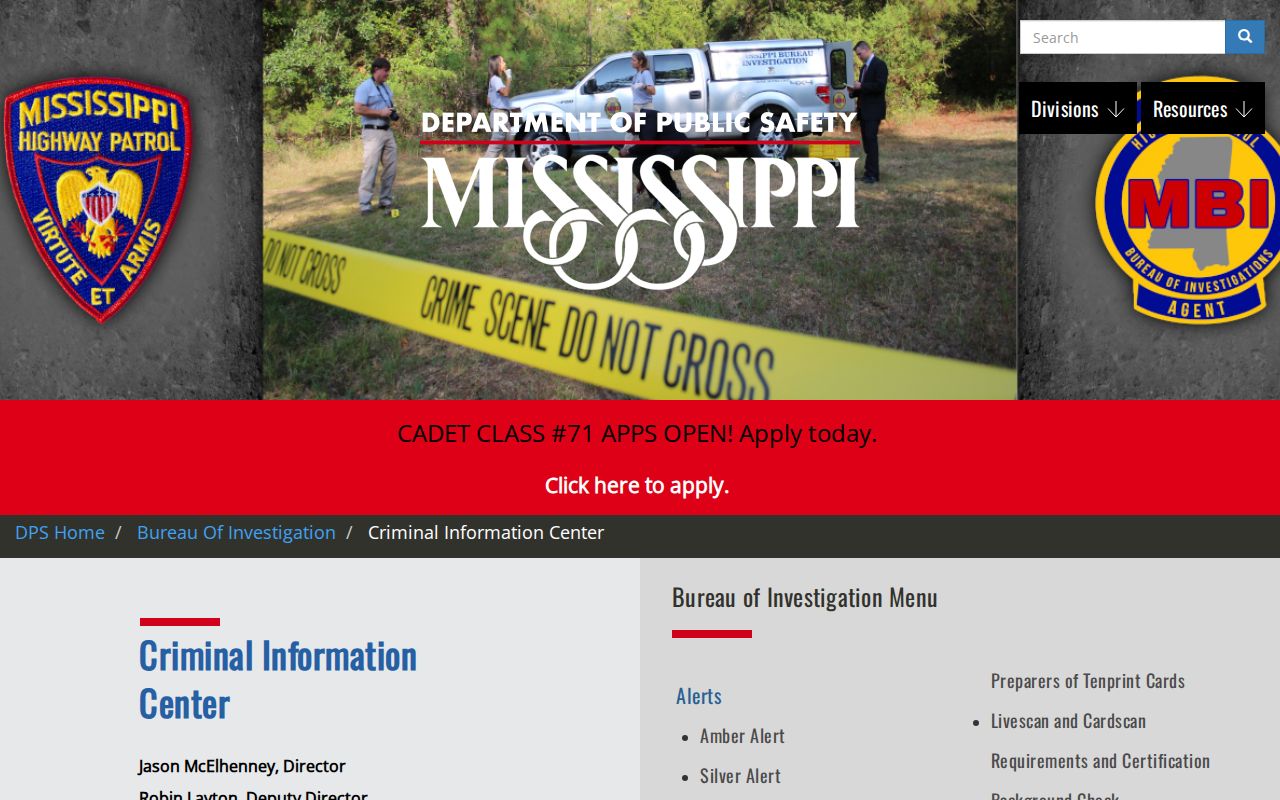
That page describes an agency information service. It is not an invitation to ask CIC or MJIC staff for a personal warrant lookup in Mississippi.
Which Mississippi Court Holds Warrant Records?
Mississippi splits its courts across several levels, each with its own clerk. Felony dockets generally run through Circuit Court, where the Circuit Clerk is the main public records contact. Justice Courts take many misdemeanors, traffic matters outside city limits, preliminary felony steps, and initial appearances. Municipal Courts cover city ordinance, misdemeanor, and city traffic cases. County Courts exist only in some counties with limited or concurrent jurisdiction. Chancery Court handles equity, probate, and family matters, not ordinary criminal warrants. The statewide directory is a locator, not a warrant index. It reports 23 Circuit districts, 20 Chancery districts, and Justice Courts in all 82 counties. Current state directory products disagree on County and Municipal Court totals, so trust the named place and court over any disputed statewide count. The 2026 courthouse list gives seat and address context, and ten counties list two seats. Confirm which district and clerk handle the case before you go in person.
| Record route | Typical Mississippi role | First contact |
|---|---|---|
| Circuit Court | Felony criminal docket and related court process | Circuit Clerk |
| Justice Court | County-level traffic, misdemeanor and initial proceedings | Justice Court Clerk |
| Municipal Court | City ordinance, misdemeanor and city traffic matters | Municipal Court Clerk named on the ticket |
| County or Chancery Court | Limited local jurisdiction or civil/family process | Confirm the court’s assigned clerk |
Warrants in Mississippi: The Main Types
The label on a warrant tells you what happened and which court to call. In Mississippi, an arrest warrant follows the legal showing and procedure in Rules 3.1 and 3.2 of the Rules of Criminal Procedure. That is the document a judge signs when the required showing has been made. A bench warrant works differently. It is a court-directed order tied to an appearance requirement that went unmet. Rule 15.2(c) lets a judge issue one when a defendant fails to appear as required. A missed date does not guarantee that outcome in every case, though. Other labels need context too. A search warrant authorizes a search, not an arrest. MEC dockets in participating courts may show "Capias Pending," and Mississippi has no uniform statewide capias pro fine rule or single payment-to-clear path. Federal fugitive process belongs to the federal court and the U.S. Marshals layer. The issuing court can tell you which term applies to your situation and what order is still in effect.
| Process | How it arises | Issuing authority |
|---|---|---|
| Arrest warrant | Judicial process after the required showing or rule-based trigger | Authorized judge or judicial officer |
| Bench warrant | Often follows a required appearance that was missed | Judge in the existing case |
| Search warrant | Authorizes a search, not an arrest | Judge under Rule 4 |
| Capias event | Docket label whose meaning depends on the case and court | Confirm with the issuing court |
| Federal fugitive process | Separate federal matter or interstate fugitive work | Federal court and authorized officers |
How Mississippi Warrants Move Into NCIC
A local order does not travel through one public, automatic statewide pipeline in Mississippi. The court creates the docket event. The clerk maintains the case record. A sheriff, constable, municipal police officer, or other authorized officer may then carry service responsibility. From there, a criminal-justice agency can enter information into the law-enforcement network. Mississippi sets no law or public technical map that requires every court or sheriff to submit every active warrant, and no uniform transfer schedule exists either.
Record path: Mississippi court order → local agency service record → authorized DPS CIC/MJIC check → NCIC/NLETS where entered.
Mississippi DPS describes CIC as the state conduit for criminal-information exchange. It also says a positive return must be verified with the entering agency. That matters. A query can be fast while the data behind it stays incomplete or differs from the local docket. A city process may sit with Municipal Court or city police. The county sheriff may not hold the court file at all. Match the court and the executing agency to your case before drawing conclusions. Note: No public source establishes a complete county-by-county feed, real-time transfer rule, or all-warrant coverage promise for Mississippi.
Mississippi Warrant Records: What They Show
There is no single standard statewide row for a Mississippi warrant record. What you see depends on the source. A public docket or official document may show a court, case category, judicial officer, process type, docket event, and date. An arrest warrant under Rule 3.2 carries rule-based content: a defendant name or description, the offense, a command to arrest, and a bail direction when appropriate. Public pages can omit restricted fields. Bond and status take separate confirmation. Docket events may read "Bench Warrant Issued," "Bench Warrant Returned," or "Capias Pending." Those are event labels seen in participating MEC courts, not a statewide live status vocabulary. A "returned" event does not tell you whether a judge recalled the process or an agency updated its record. Ask the clerk to interpret the actual entry.
| Warrant number | A court or agency identifier, if shown; no uniform statewide public format was located. |
|---|---|
| Subject | Name or description required by the process; restricted records may not be public. |
| Charge or offense | The cited allegation or case category, not a final finding of guilt. |
| Issuing court | The court and jurisdiction to contact about the order. |
| Bond direction | Case-specific information set by the court; confirm amount and conditions with the clerk. |
| Status or event | A docket or agency entry that may need current confirmation from its custodian. |
Mississippi Warrant Docket Labels Need Context
Electronic dockets can help you find a case event. A label is not a live law-enforcement response, though. A public docket in Mississippi may show an order entered or returned without showing when each agency updated its own system. MEC access varies by local adoption. It also excludes sealed or restricted material. For a personal case, ask the issuing clerk what the entry means today and which office can verify service status.
- Bench warrant
- A judge-directed order that can follow a required court appearance that was missed.
- Capias
- A term appearing in some Mississippi docket events; its specific meaning depends on the issuing court and case.
- Returned
- A docket event showing process was returned to court; ask whether the case or order remains open.
- Recall
- A court action withdrawing or ending a warrant; the issuing court controls it.
- Quash
- A court order setting aside process. A reader should ask the court or attorney whether it applies.
- Bond forfeiture
- A separate court process after a bond-backed appearance is missed; it is not the warrant itself.
These terms help you ask a precise question without treating one screen as the whole case file. In Mississippi, the local court remains the authority on its own docket.
Mississippi Traffic Warrants and License Holds
A missed traffic date and a license suspension are two separate questions in Mississippi. A ticket written inside a city may belong to Municipal Court. Traffic outside municipal jurisdiction usually goes to Justice Court. Ask that court first: did it issue process, what balance or appearance is due, and does a judge need to recall an order? The state runs no public statewide traffic-warrant search or FTA lookup, and no uniform warrant fee exists. The Driver Service Bureau (DSB) handles license reinstatement separately. Its current page lists $100 categories for FTA reinstatement, FTP reinstatement, and suspension citation. That is a DSB fee category. It is not a court fine, warrant fee, or bond. A court may need to send a corrected abstract or clearance before DSB can review reinstatement. Court action alone does not confirm license status.
| Question | Mississippi record holder | What to confirm |
|---|---|---|
| Is a traffic warrant active? | Issuing Municipal or Justice Court, plus service agency | Current process and required court action |
| Is a license suspended? | Driver Service Bureau | Suspension category, current fee, and received court clearance |
| Did an online payment resolve the warrant? | Issuing court | Separate recall or closure confirmation |
Note: Mississippi publishes a reinstatement fee category, but it is not tied to every in-state traffic failure to appear.
Warrant Record Access Under Mississippi Law
The Mississippi Public Records Act of 1983 covers records held by public bodies, subject to exemptions. A narrow request can seek an existing record from the agency that holds it. It cannot make an office create a record, answer a legal question, or expose protected law-enforcement information. Court files follow court access rules and local restrictions. A docket available through PAMEC covers only participating courts and nonrestricted filings. Juvenile and sealed matters carry additional limits. Active investigative information may be withheld or redacted under applicable rules. Someone hunting a court filing should contact that court's clerk rather than send a broad request to DPS. A records request is not an authorized CIC/MJIC query and gives no real-time confirmation.
Key Mississippi authorities:
Miss. Code Title 25, Chapter 61 governs public-record requests and exemptions.
Miss. Code §§45-27-5 and 45-27-7 establish CIC’s criminal-information role; they do not create public warrant access.
Miss. Code §99-3-47, as amended by 2026 SB 2230 addresses electronic warrant applications, not a public registry.
Mississippi Electronic Warrants Are Not a Search Portal
Mississippi updated its electronic warrant process in 2026. SB 2230 amended §99-3-47 so misdemeanor warrants can now be sought electronically, alongside the safeguards already in place for applications and signatures. The law covers secure transmission, time logging, and live interaction with a judge by video or teleconference. One limit stands out. Electronic form alone does not authorize a no-knock warrant. All of this changes how a Mississippi warrant may be requested and issued, not whether the public can look one up; no statewide search portal was created. The official SB 2230 text lays out the application safeguards, and the bill history records gubernatorial approval on March 13, 2026. The bill text is what the official page displays, not an actual warrant application or an individual case. Check the current codification before citing a changed code section.
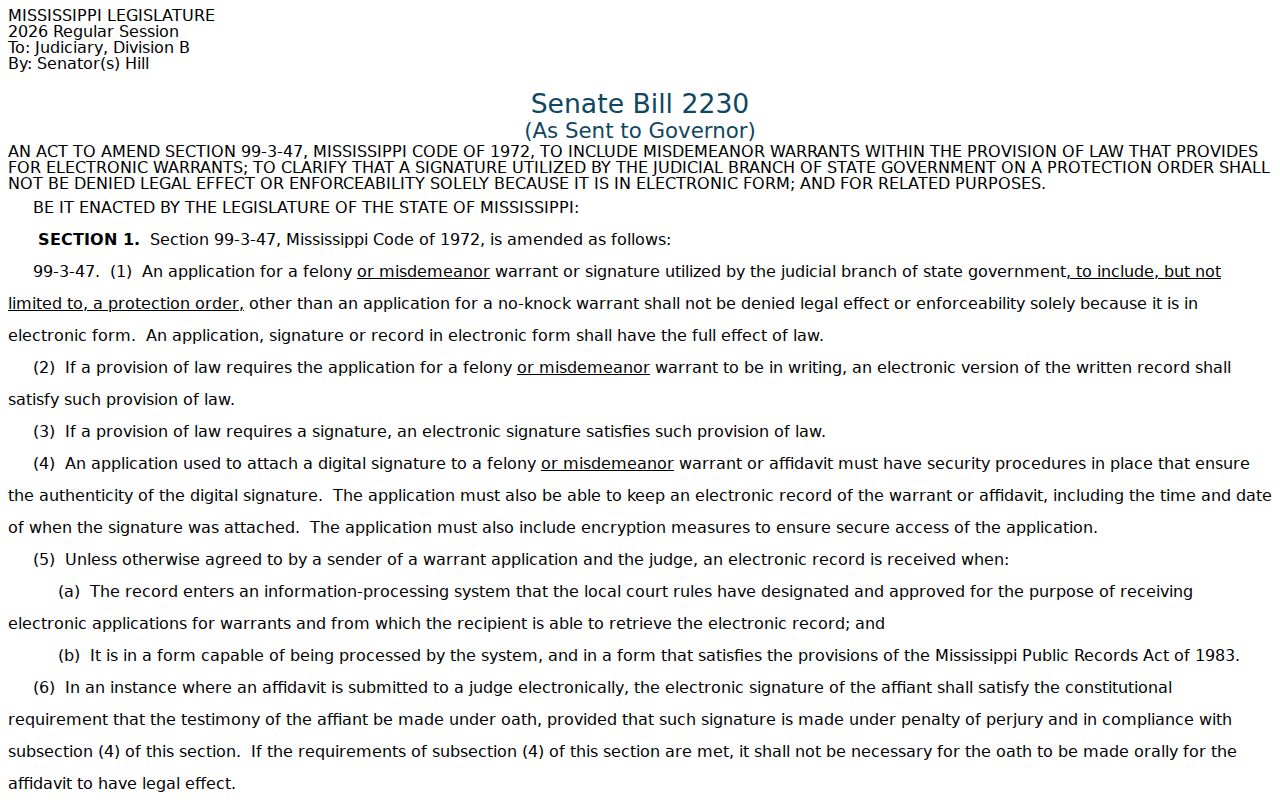
Mississippi courts got a new way to handle warrants and electronic records. Where you confirm a specific warrant's status did not change one bit.
How to Resolve a Mississippi Warrant
A Mississippi warrant does not vanish because a docket sits quiet or a fine gets paid. Only the issuing court can recall or quash it, serve it, or close it out. A recall is the court withdrawing the warrant; quashing sets the process aside. The clerk can walk you through filing and appearance steps. A licensed attorney can advise on arrest risk, bond forfeiture, and whether counsel may appear for you. If the Mississippi warrant is your own, gather the citation or case number first. Call the court's official phone or clerk route before making a trip. Ask which agency received the process, whether a judge must act, and whether a new date or bond is required. Get written confirmation of how it will be recorded. Do not assume a payment portal or sheriff's roster updates the court order.
- Identify the court and case from the citation, notice, or docket.
- Ask the clerk whether a warrant is currently active and what appearance, motion, or balance remains.
- Discuss surrender, bond, or a motion to recall or quash with an attorney when the matter may lead to arrest.
- After court action, request a written disposition and ask which agency must update any service record.
- Check any separate driver-license matter with DSB only after resolving the court issue.
Mississippi Has No Statewide Warrant Amnesty
Mississippi has no statewide warrant amnesty. It also has no uniform roundup program. A dated local event is not a policy for every Mississippi court. Biloxi once published a 2016 notice about resolving certain outstanding cases, but that one-time event set no current statewide offer or eligibility rule. Any relief event must be confirmed through the issuing court's current official notice. Federal matters run on a separate track. They go through the Northern or Southern District of the U.S. District Court and the U.S. Marshals, and PACER can show public federal case activity, though sealed process or every warrant record may not appear there. A county jail booking does not prove a federal warrant remains active. Keep state or local court inquiries separate from federal confirmation. Note: No official statewide warrant total or amnesty schedule exists, so never infer list counts from public fugitive notices.
Warrant Records by County in Mississippi
Which court or sheriff holds a given Mississippi warrant depends on where the case began. These six counties are the state's largest by the 2024 population estimates, but population is not warrant volume. Their official local routes differ too. So start with the citation and the court, not an assumed statewide office.
Harrison County
Biloxi and Gulfport · two court districts; Biloxi has its own Municipal Court.
Hinds County
Jackson and Raymond · docket labels should be confirmed with the issuing clerk.
DeSoto County
Hernando · the Sheriff routes warrant questions to its Fugitive Division by phone.
Rankin County
Brandon · the public inmate roster is custody data, not a warrant index.
Jackson County
Pascagoula · the reviewed Sheriff page gives contact information, not a public warrant search.
Madison County
Canton · use the relevant court and clerk route for the specific case.
The full directory of all 82 Mississippi counties reaches every county subdomain. Got a city citation? Confirm the Municipal Court named on the ticket, even when that city sits inside a county.